
Blanc
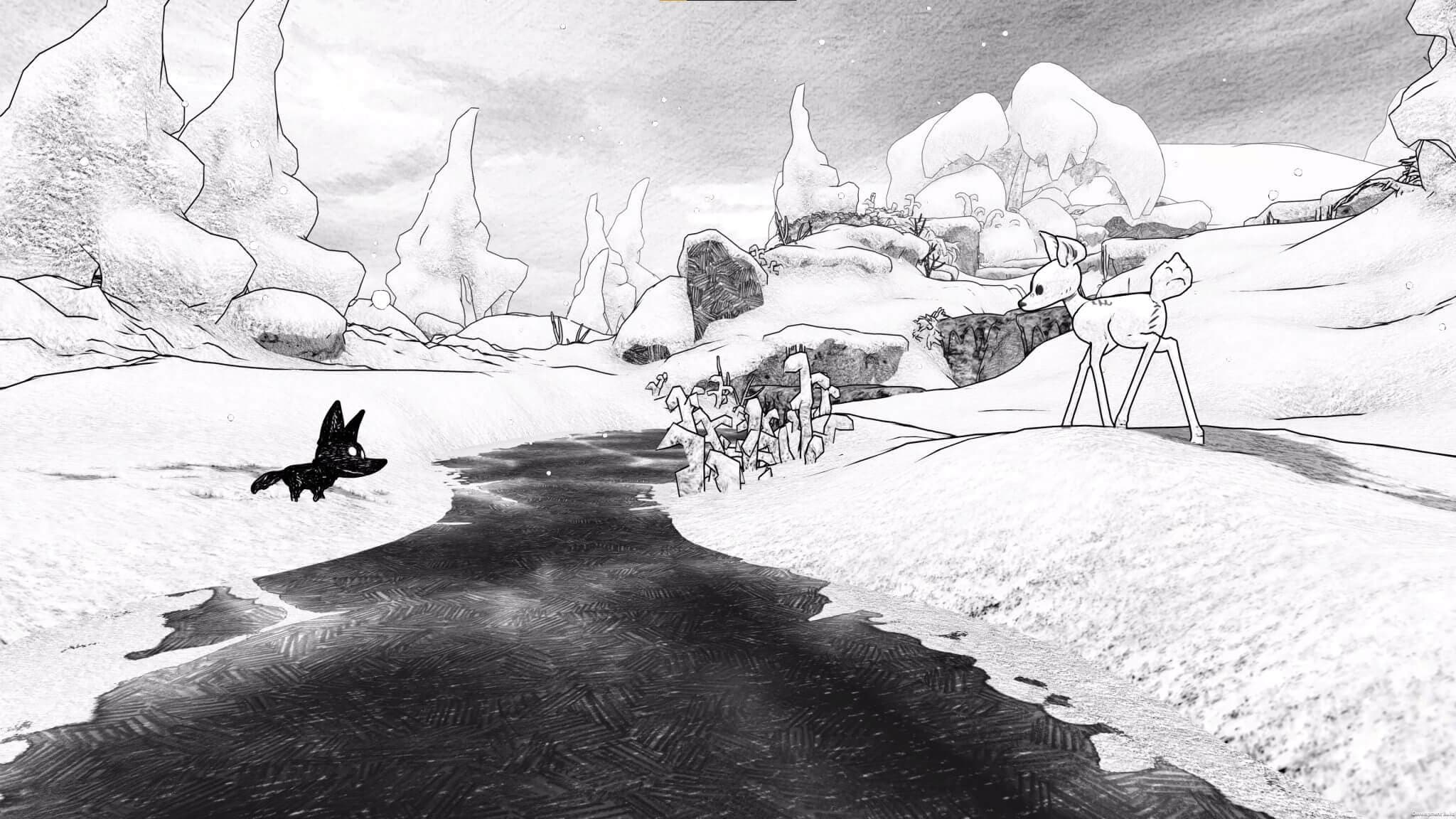
Blanc is a narrative and contemplative adventure set in a snowy 3D world, where you follow the story of a wolf cub and a fawn, two beings who are polar opposites, lost in a snowstorm. To find their way home, they must follow the tracks of their respective families across icy and hostile landscapes.
In 2-player co-op, take on the roles of the wolf cub and the fawn, and use their unique abilities to overcome the challenges of nature. The wolf cub, agile and cunning, can slip through tight spaces thanks to its small size, while the fawn, slower but larger, can jump higher. Together, they must learn to cooperate despite their differences to survive in this unforgiving world.
The gameplay of Blanc draws inspiration from contemplative adventure games like Journey and The Last Guardian, while incorporating survival mechanics and puzzle-solving. The universe, on the other hand, takes its inspiration from the stark beauty of snowy landscapes and timeless tales about nature and coexistence.
The goal is to offer an immersive and emotional experience, where players are plunged into a silent and poetic world. Through minimalist environments and subtle visual storytelling, Blanc invites reflection on universal themes such as mutual aid, difference, and the quest for self.
- Roles
- Gameplay Programmer, Tools Programmer, Game Designer
- Year
- 2021
- Tools/Technology
- Unity, Odin Inspector, Rewired
- Collaborators
- Casus Ludi, Gearbox Publishing
Présentation
Working on Blanc was an incredibly enriching experience, though I unfortunately cannot share production images or Unity screenshots due to my contract with Gearbox. I joined the project at the beginning of 2021, when development was already underway. The team initially consisted of one developer handling architecture, tools, and optimization, as well as another, more junior developer (who later became the project lead after my arrival), focusing on gameplay. Later, a senior gameplay developer also joined us.
At first, my role primarily involved working on the main characters (the Fawn and the Cub), where I coded mechanics related to movement and environmental interactions. One of the first major features I worked on was the Push/Pull system for environmental objects. This system went through several iterations, as a decision was made shortly after my arrival to completely avoid using Rigidbody or any physics-based interactions.
As the project progressed, I took charge of developing all the NPCs in the game. My first task was implementing the ducks, using a simple NavMesh Agent and a state machine. Between AI development phases, I also contributed to creating tools for the Level Design team and handled debugging tasks. I developed several runtime tools to give Gearbox more flexibility during build testing, such as no-clip, teleportation, wireframe collider visualization, and other features tailored to their needs.
Before diving into AI development, I always started with a phase of technical research and game design planning. One of the most complex features I worked on was the goat AI. The goats had two distinct behaviors: the first involved mirroring the movements and actions of the Fawn and Cub relative to a wall (acting as a mirror), while the second involved following the Fawn or Cub using a NavMesh Agent. This required smooth jump animations and variations in behavior to make the interactions feel natural.
Working on Blanc taught me a great deal. I learned the importance of a solid architecture for ensuring a project's long-term success, as well as the value of Addressables for asset management and code optimization (such as managing the garbage collector, for example). I also discovered how tools like Odin can streamline development by avoiding reinventing the wheel and creating clearer, more aesthetically pleasing tools. Finally, I gained experience in implementing managers to reduce spaghetti code and in building robust state machines.
Media 1 of 5